When you send a query to Google, it replies you back. Have you ever wondered and tried to figure out that how Google replies you? How Google knows that its only you who want reply? Why the reply by Google is not sent to all the devices connected in network? How Google figures it out which reply to be sent to which device only? OK, leave Google, Let’s suppose your are in your office and you want to communicate with only one PC, but how do router figures out that where to send the query? Why the router in your office don’t send reply to all the devices connected to that network? Aren’t you curious how communication is happening on Internet? The one word answers to all these questions and that one word is “IP Addressing”.
IANA(Internet Assigned Numbers Authority) is responsible for global coordination of the Internet Protocol addressing systems, as well as the Autonomous System Numbers used for routing Internet traffic. Users are assigned IP Addresses by Internet Service Providers (ISPs). ISPs obtain allocations of IP addresses from Local Internet Registry (LIR) or National Internet Registry (NIR).
Internet Protocol Addressing abbreviated as IP Addressing is a 32-bit address assigned to every device connected to Internet. In Internet world, your device is known by this IP Address, not by your name. This 32-bit Address is divided into 4 partitions by a dot adn can be called as 4 octets. Every 8 bits (one part of partition, one octet) ranges from 0-255 in decimal. This range can be calculated as:
Minimum 8-bit: 00000000 in binary = 0 in decimal
Maximum 8-bit: 11111111 in binary = 255 in decimal
So, now for 32-bit, IP addresses ranges from:
Minimum: 00000000.00000000.00000000.00000000 = 0.0.0.0
Maximum: 11111111.11111111.11111111.11111111 = 255.255.255.255
From the above calculations, we can say that no part of the 32-bit IP address can be greater than 255 or lower than 0. Few simple examples of IP Addresses are:
– 1.1.56.1
– 150.154.76.6
– 192.168.0.4
– 228.54.77.121
In your PC you can view the IP addresses in decimal and they must be similar to above examples. But router or any device cannot read in decimal so, they convert it to binary and then use these addresses for further communication.
So, now depending on the first 8-bits and their range, IPs are divided into 5 classes. Before explaining these classes, you must know how of Address, Subnet, Subnet Mask, Network and Host bits, Interface.
Address: The unique number ID assigned to one host or interface in a network.
Subnet: A portion of a network that shares a particular subnet address.
Subnet Mask: A 32-bit combination used to describe which portion of an address refers to the subnet and which part refers to the host.
Network and Host Address: The network address is used to identify the network and is common to all the devices attached to that network. Host Address is the remaining portion of IP address that is specific for every device and is used to identify that specific device.
Interface: A network connection.
Now, lets study the classes and IP addressing deeply.
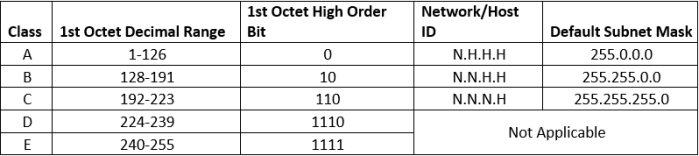
1- Class A:
Actual Range: 0-127 but this class is used for commercial purposes by commercial purposes mean, IPs ranging in that class are sold at some fixed prices. But, 0 is fixed for current network i.e. host to neighbor connection. And, 127 is fixed for localhost i.e. loopback IP.
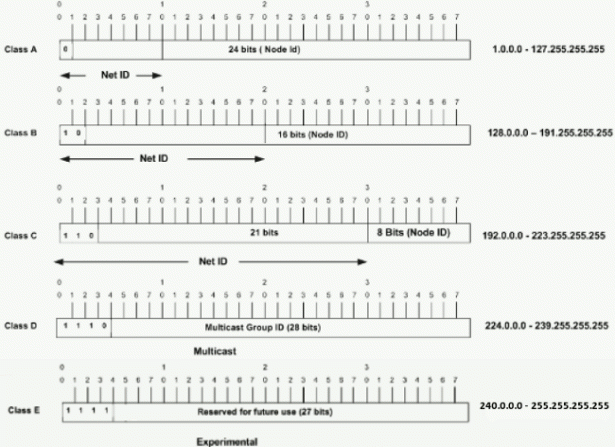
So, we can say that IP addresses starting with 0 are fixed for neighbor connection and IPs starting with 127 are fixed for localhost devices. IP Addresses starting with 0 means “0.X.X.X” where, X can be any value from 0-255. And IP Addresses starting from 127 means “127.X.X.X”. Therefore, its range in table is written as 1-126. Now if you convert 1-126 in binary, you will get “0” as its most significant bit. Converting the First octet into binary and then checking its 1st Order High octet bit will make easier to find the class of any given IP address for device. For example, lets convert 1 to binary. You will get “00000001” and now convert 126 into binary and you will get “011111110”. These are the minimum and maximum numbers of class A range.
Now lets discuss Network and Host ID. As described earlier Network address is the fixed address of the network. For class A, first octet tells the network Address and therefore, its subnet mask is 255.0.0.0. Subnet masks tells, first octet will be the network address and remaining three octets are Host IDs. For example, 122.220.0.199 is an IP Address of Class A. “122” shows its from Class A and class A shows its subnet mask will be 255.0.0.0. And Network Address of this IP will be 122.0.0.0 and Host Address will be 0.220.0.199.
2- Class B:
The range of class B is 128-191. This means, if first octet of IP Address is from 128-191 then that IP belongs to Class B. The first bits of first octet will be “10”. For example, lets convert 128 to binary and you will get “10000000”. If you convert 191 to binary, you will get “10111111”. Subnet Mask is 255.255.0.0 hence, first two octets will tell the Network Address. So, for example, if we have an IP 140.70.199.0, then 140.70.0.0 shows the Network address.
3- Class C:
The range of class C is 192-223. This means, if first octet of IP Address is from 192-223 then that IP belongs to Class C. The first bits of first octet will be “110”. For example, lets convert 192 to binary and you will get “11000000”. If you convert 223 to binary, you will get “11011111”. The minimum IP Address will be “192.0.0.0” and the maximum can be “223.255.255.255”. Subnet Mask is 255.255.255.0 hence, first two octets will tell the Network Address. So, for example, if we have an IP 200.70.199.0, then 200.70.0.0 shows the Network address.
4- Class D:
All the above mentioned classes (Class A- Class C) are for commercial purposes. But the Class D is different from them. Class D is used for multicasting purposes and IPs of this class are reserved for special use. The range of class D is 224-239 and the first bits of first octet should be “1110”. For example if you convert 224 to binary, you will get “11100000” and if you convert 239 to binary, you will get “11101111”.
You can consider this class as color of number plates reserved for government. For example in Pakistan, green colored Number plates are reserved for Government cars and such numbers are not sold to local private cars. Similarly, the IPs of this class are reserved and are not sold.
5- Class E:
The range of this class is 240-255. The first bits of first octet should be “1111”. For example if you convert 240 to binary, you will get “11110000” and if you convert 255 to binary, you will get “11111111”.
This class is also not for commercial purposes. The IPs of this class are reserved for testing purposes and are assigned to labs or projects for testing on demand.
All of this must have left you scratching your head probably. Don’t worry, you will learn everything soon! I hope, this will be helpful for you!
Please comment, if I missed anything or misstated anything.
Thanks!


Woah! I’m really digging the template/theme of
this website. It’s simple, yet effective. A
lot of times it’s difficult to get that “perfect balance” between superb usability and visual appeal.
I must say you’ve done a excellent job with this.
In addition, the blog loads super fast for me on Safari.
Excellent Blog!
LikeLike
I am in fact happy to read this web site posts which includes tons of valuable information,
thanks for providing such statistics.
LikeLike
Pinot Noir
LikeLike
Hello! I’ve been reading your web site for
some time now and finally got the courage to go ahead and give you a shout out from Houston Tx!
Just wanted to tell you keep up the good job!
LikeLike
I’m not that much of a internet reader to be honest
but your blogs really nice, keep it up! I’ll go ahead and bookmark
your site to come back in the future. Cheers
LikeLike
I absolutely love your website.. Excellent colors & theme.
Did you build this amazing site yourself? Please reply back as I’m
hoping to create my very own blog and would like to learn where you got this from or
just what the theme is named. Appreciate it!
LikeLike
Pretty component to content. I simply stumbled upon your weblog and in accession capital to say that I acquire actually enjoyed account your weblog posts.
Anyway I’ll be subscribing in your augment or even I success you get right
of entry to consistently rapidly.
LikeLike
Good day! I just want to give you a big thumbs up for the excellent info you have got
here on this post. I’ll be returning to your site for
more soon.
LikeLike
I read this article fully on the topic of the comparison of most up-to-date and preceding technologies, it’s remarkable article.
LikeLike
Good article. I am facing some of these issues as well..
LikeLike
Your means of explaining all in this piece of writing is
truly nice, all be capable of without difficulty know it,
Thanks a lot.
LikeLike
Your mode of describing everything in this article is really nice,
all be capable of easily be aware of it, Thanks a lot.
LikeLike
Nice post. I understand something tougher on different blogs everyday. Most commonly it is stimulating you just read content off their writers and use a little something there. I’d choose to apply certain together with the content on my blog regardless of whether you don’t mind. Natually I’ll provide a link for your internet blog. Many thanks sharing.
LikeLike