Before moving towards the Difference of these two important models, question is, What is OSI Model and What is TCP/IP Model?
I already have discussed these two models in detail in my previous posts. Kindly visit, OSI Reference Model and TCP/IP Reference Model for understanding these two models in detail.
Lets start noting down all differences between these two models:
| OSI Reference Model | TCP/IP Reference Model |
|---|---|
| It is 7-layered Model. | It is 4-layered Model. |
| It is considered as generic, protocol-independent standard. | It is considered as the standard around which the Internet has developed. |
| It is less reliable than TCP/IP Reference Model. | It is more reliable than OSI Reference Model. |
| It is considered as reference/guidance tool only. | It is actually the implementation of OSI Model. |
| It has strict boundaries. | It is more flexible and tangible Model. |
| It follows vertical approach. | It follows horizontal approach. |
| It has separate Presentation and Session Layers. | Presentation and Session Layers are considered as a part of Application Layer |
| It offers support for connection-less and connection-oriented communication. | It offers support for connection-less communication only. |
| Transport layer Guarantees the transfer of Packet. | Transport Layer does not guarantee the transfer of Packet. |
| It is Protocol independent Model. | It is Protocol Dependent Model. |
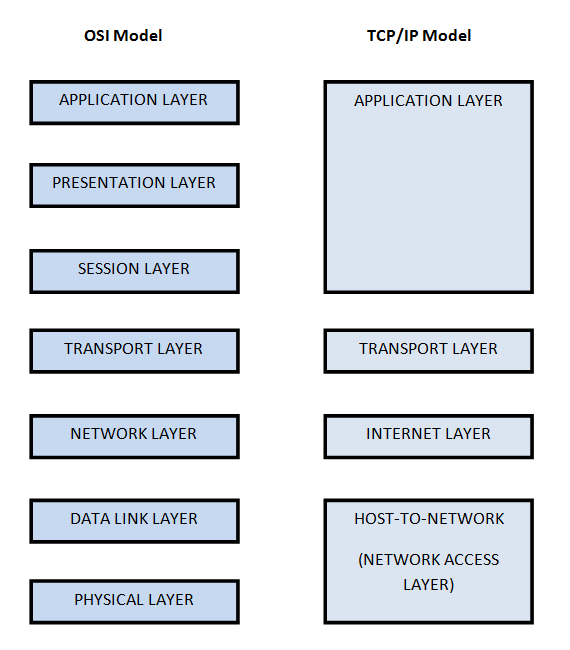
Above mentioned are the major differences of between TCP/IP and OSI Reference Model.
I hope this will be helpful for a lot of people who still have confusion! Please comment, if you know something else which I missed or stated incorrectly.
Thanks!
 Zainub Wahid